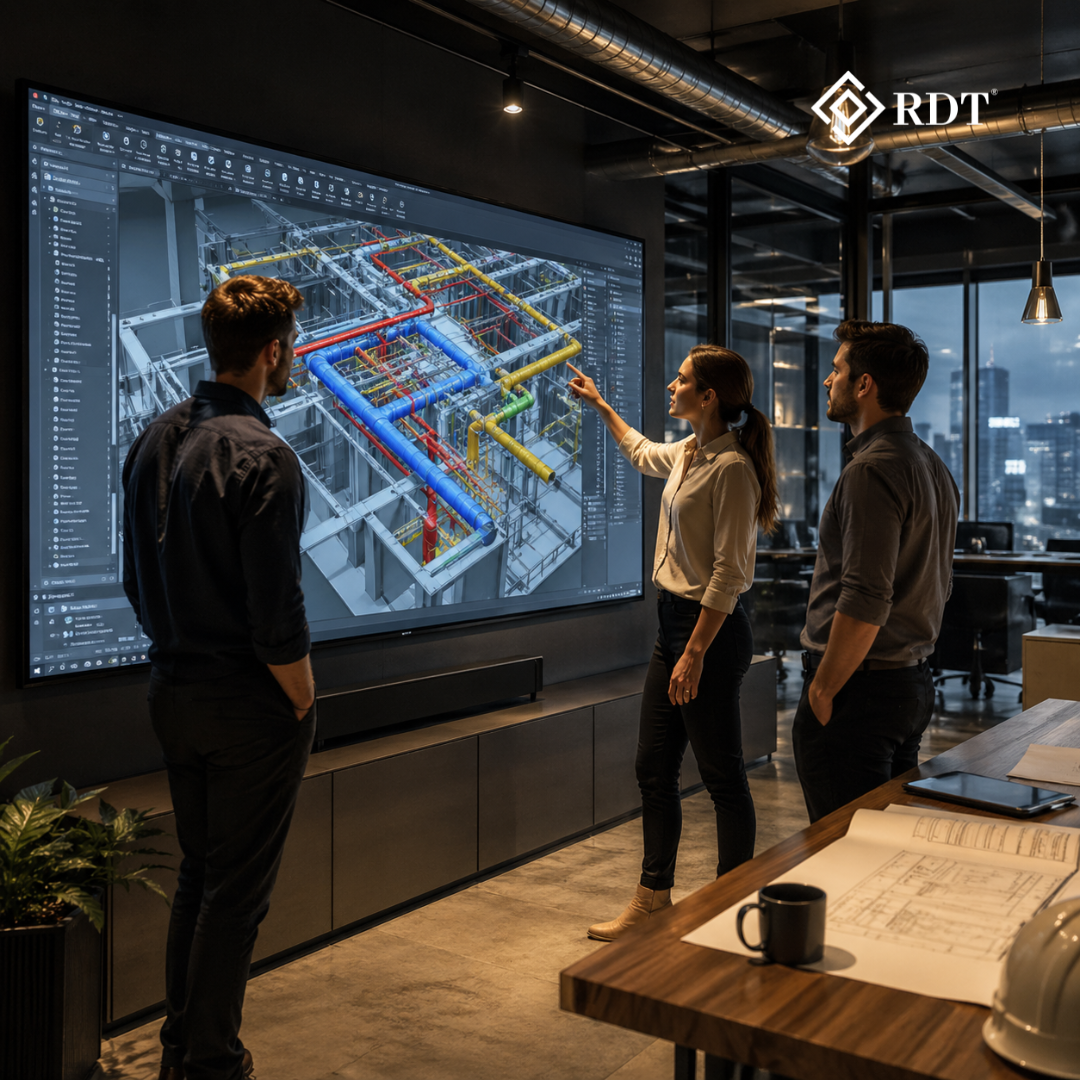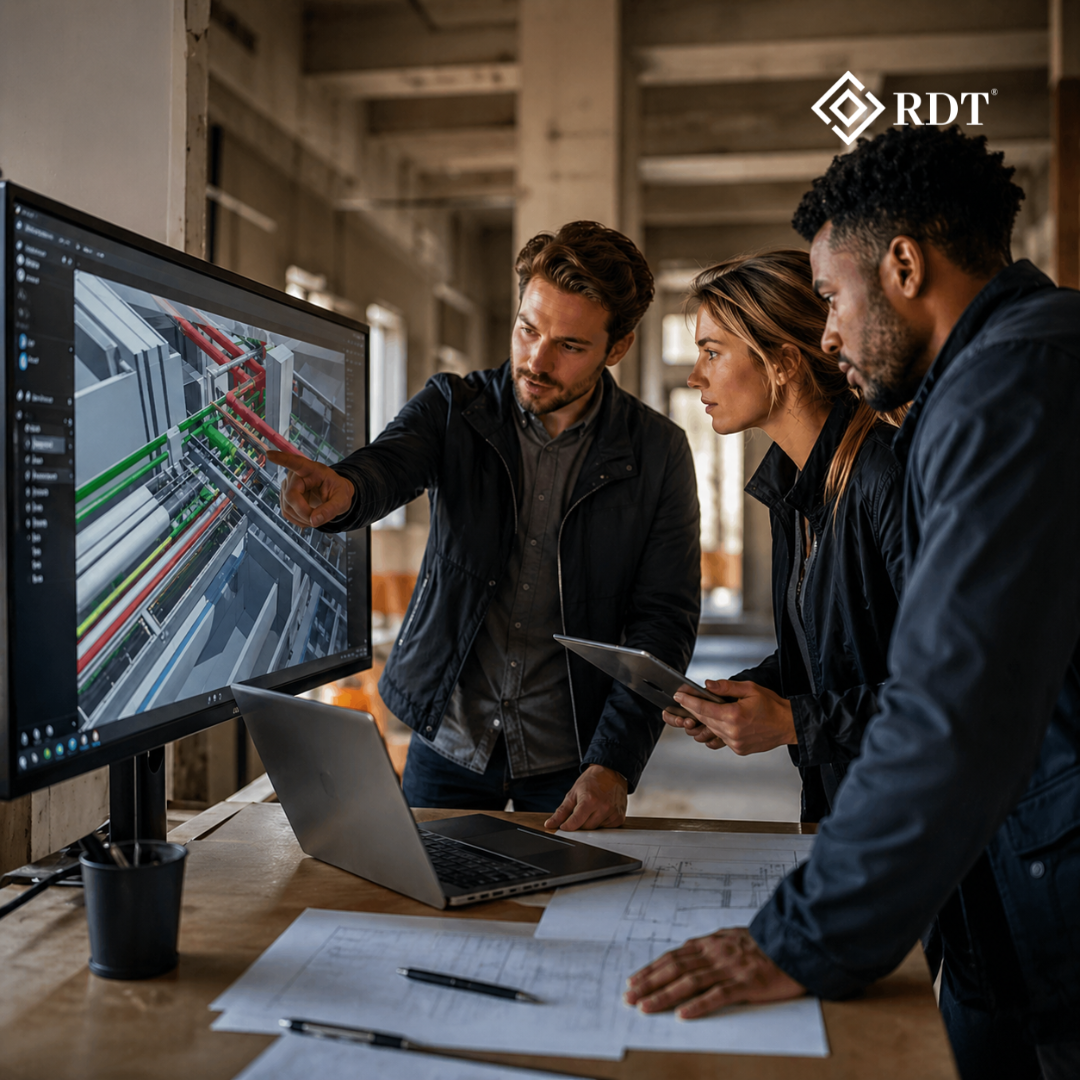
The construction & AEC industry today is merciless. Timelines are strict, client hopes are superior, and every small coordination mistake risks snowballing into expensive rework, postpones, and reputational harm. In this aggressive atmosphere, BIM is not only a preferred flow of work—it’s the only workflow that keeps multidisciplinary squads coordinated, minimizes mistakes, and drives a project from concept to completion with accuracy.
But here’s the catch:
BIM only works when you work BIM the right way.
Over the years, RDT has analyzed hundreds of BIM-enabled projects, collaborated with global AEC teams, and refined a workflow that doesn’t just “support” construction—it transforms it. In this journey, we noticed a pattern: seven deadly mistakes that silently drain efficiency, damage coordination, and increase risks.
This article breaks them down, explains their impact, and shows how RDT’s optimized BIM workflow prevents each one.
1. Failing to Standardize BIM Processes From Day One
The biggest mistake teams make is assuming everyone understands BIM the same way. Without clear standards, every stakeholder models differently, documents differently, and interprets data differently. This leads to:
- Inconsistent element naming
- Unclear model purposes
- Clashing modeling styles
- Misaligned LOD expectations
- Confusion during handover
Why it’s deadly:
Even the finest software can not save a project constructed on inconsistent fundamentals. The outcome is rework, slow sanctions, and vague project progress.
RDT’s Workflow Fix:
We start with a defined BIM Execution Plan (BEP) that establishes standards, responsibilities, LOD definitions, collaboration protocols, naming conventions, and model usage guidelines. This guarantees everybody speaks the similar “BIM language” before modeling even starts.
2. Treating BIM as a 3D Drawing Tool Rather than a Datacentric Procedure
Numerous squads still see BIM as glorified 3D modeling. This mindset kills project accuracy and wastes the actual power of digital construction.
BIM is not about creating pretty models.
It’s about creating intelligent, data-rich systems that predict problems before they appear.
Why it’s deadly:
Without data intelligence, BIM becomes a visual reference instead of a decision-making tool. This destroys its value in costing, scheduling, clash detection, and facility management.
RDT’s Workflow Fix:
Our workflow ensures every modeled element carries the right metadata—parameters, properties, classifications, and structured data aligned with project goals.
We don’t just model buildings.
We build digital assets that behave like buildings.
3. Ignoring Early-Stage Coordination
Most coordination issues arise not during construction but during design—and many teams wait too long before checking model compatibility.
By the time clashes are discovered, the damage is already costly.
Common consequences of late coordination:
- Unexpected site changes
- Mechanical routing conflicts
- Structural redesigns
- Architectural modifications
- Delays in procurement
Why it’s deadly:
Just one unresolved clash between MEP and structure can cost weeks of redesign work.
RDT’s Workflow Fix:
Our workflow integrates continuous clash detection, starting from early design and continuing through every stage. We use automated audits, federated model reviews, and multi-domain coordination to eliminate issues before they escalate.
4. Overlooking Version Control and Model Management
Too many teams work on outdated or duplicate models.
Revisions get lost.
Too many updates are poorly documented.
This results in:
- Teams working on expired models
- Conflicting revisions
- Data loss
- Undefined model ownership
- Inability to track changes
Why it’s deadly:
A single outdated file can derail entire teams and cause major construction misalignment.
RDT’s Workflow Fix:
We implement strict CDE (Common Data Environment) protocols with structured versioning, permission-based access, and clear revision tracking. Everyone works on the right file, every time, with zero confusion.
5. Not Aligning LOD With Project Milestones
Many teams model too little, too late—or too much, too early.
Both are expensive mistakes.
LOD mismatch causes:
- Missing details during coordination
- Overloaded models that kill performance
- Wasted modeling hours
- Miscommunication between consultants
- Delays during approvals
Why it’s deadly:
The project moves forward, but the model doesn’t match its requirements—leaving teams blind during critical phases.
RDT’s Workflow Fix:
We map out LOD progression that aligns with project phases:
Concept → Schematic → Detail → Construction → As-Built.
This ensures the model always supports the stage, neither underdeveloped nor overcomplicated.
6. Neglecting Documentation, Schedules, and Deliverables
BIM is not only about modeling.
Documentation is where BIM proves its value.
But many teams:
- Produce uncoordinated drawings
- Ignore sheet management protocols
- Generate schedules with missing data
- Deliver inconsistent outputs
- Fail to maintain annotation standards
Why it’s deadly:
Contractors depend on documentation.
If drawings aren’t clear, construction fails.
RDT’s Workflow Fix:
Our process integrates:
- Intelligent sheet setups
- Automated schedule generation
- Template-based annotation
- Quality checks before every issue
- Structured publish sets
The result? Predictable, clean, and construction-ready documentation delivered every time.
7. Failing to Integrate BIM With Real-Time Collaboration Tools
Today’s projects require continuous communication.
But many teams still rely on fragmented messaging, informal updates, and scattered files.
The consequences:
- Missed updates
- Unclear responsibilities
- Slow decision-making
- Long approval cycles
- Reduced visibility into project progress
Why it’s deadly:
A BIM project without association is similar to a car without a steering wheel—seems fine but goes nowhere.
RDT’s Workflow Fix:
Our BIM workflow incorporates:
- Cloud collaboration (Autodesk BIM360, ACC, etc.)
- Real-time model syncing
- Comment-based coordination workflows
- Update tracking dashboards
- Cross-team communication pathways
Everyone stays aligned, informed, and accountable.
How RDT’s BIM Workflow Eliminates These 7 Deadly Mistakes
RDT’s BIM Workflow Overview is built around a simple philosophy:
Structured BIM = Predictable Projects
Predictable Projects = Zero Surprises
Zero Surprises = Successful Delivery
Here’s how our approach empowers AEC teams:
✓ A well-defined BEP ensures clarity from Day 1
Every stakeholder knows their role, standards, and expectations.
✓ Data-rich modeling ensures accuracy
BIM operates as a digital twin instead of 3D sketch.
✓ Constant coordination blocks last-minute accidents
Issues are resolved before they reach the site.
✓ Robust model management keeps teams synchronized
The right people work on the right versions at the right time.
✓ LOD is carefully aligned with milestones
No over-modeling, no under-modeling—just precise development.
✓ Clear documentation accelerates construction
Contractors receive flawless drawings and schedules.
✓ Real-time collaboration keeps everyone aligned
Decisions are quicker, obligations are transparent, and development is clear.
Sum Up
BIM is the backbone of modern construction—but only when executed correctly. The seven deadly mistakes listed above aren’t just inefficiencies; they’re silent threats that can undermine even the best architectural, structural, or MEP designs.
RDT’s BIM flow of work has been polished to wipe out these risks completely.
From organized details to real-time coordination, we guarantee your project stays expected, controlled, and accurate.
If you want to build faster, smarter, and with greater accuracy—
you need more than BIM.
You need BIM done right.
You need the RDT way.