For most of its history, construction was determined by physical attempt, disconnected approaches, & on-site problem solving. Decisions were built in meetings, drawings lived in silos, and problems were resolved only after they surfaced in the field. Technology existed—but it rarely connected the entire system.
That reality changed in 2025.
What once operated as isolated construction sites has evolved into digitally connected systems—where data flows continuously, decisions are informed before execution, and projects are managed as living ecosystems rather than static plans.
2025 was not just another year of innovation.
It was the year construction crossed a threshold.
This is how construction technology developed in 2025—and where it is aimed next.
The Old Construction Model: Disconnected by Design
To appreciate the scale of change, it’s important to understand the problem construction technology was trying to solve.
Traditionally, construction operated in fragments:
- Designers worked in one environment
- Contractors worked in another
- Site teams relied on printed drawings
- Owners received information after completion
Each phase handed off responsibility—and risk—to the next. Technology was present, but it rarely spoke the same language across stakeholders.
The result?
- Misalignment between design and execution
- Cost overruns driven by late discoveries
- Schedules that reacted instead of predicted
- Data lost at every transition
Construction didn’t lack tools.
It lacked connection.
2025: The Shift From Tools to Systems
In 2025, the industry stopped adopting technology as isolated tools and began implementing connected digital systems.
This was the defining change.
Instead of asking:
“What software should we use?”
Teams started asking:
“How does information move across the entire project lifecycle?”
That shift redefined everything—from BIM and AI to project delivery and asset management.
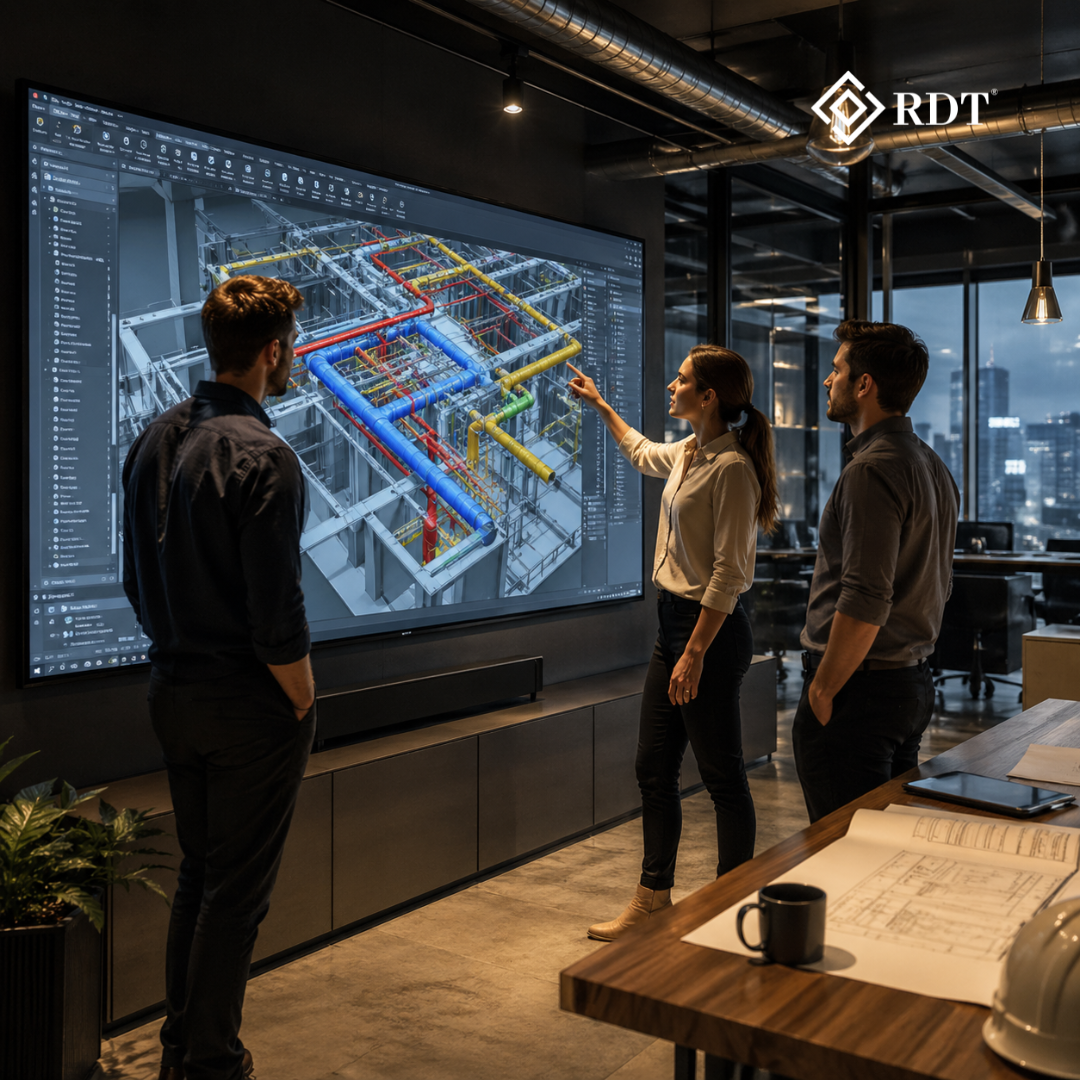
BIM Became the Central Nervous System
By 2025, Building Information Modeling (BIM) had developed a lot further 3D representation.
BIM became the central nervous system of construction projects.
- Geometry connected to data
- Data connected to schedules
- Schedules connected to costs
- Costs connected to decisions
Instead of existing as an independent model, BIM combined with:
- Common Data Environments (CDEs)
- Project management platforms
- Cost control systems
- Site progress tracking tools
The model was no longer something teams looked at.
It became something the project ran on.
AI Entered the Jobsite—Quietly but Decisively
Artificial Intelligence didn’t arrive in construction with dramatic headlines or robots replacing workers. Its impact in 2025 was far more subtle—and far more powerful.
AI began working behind the scenes, analyzing patterns humans couldn’t process at scale.
Where AI Made the Biggest Impact
- Predicting coordination risks
- Forecasting schedule delays
- Identifying cost escalation trends
- Prioritizing high-risk design zones
Instead of reacting to problems, teams received early warnings. Construction began shifting from reactive firefighting to predictive control.
AI didn’t replace expertise—it enhanced it.
From Paper Trails to Digital Continuity
One of the most underrated transformations of 2025 was documentation.
Construction documentation shifted from:
- Static drawings
- Disconnected PDFs
- Manual revisions
to digitally linked information systems.
Smart documentation connected:
- Drawings to BIM models
- Specifications to parameters
- RFIs to design intent
- As-builts to asset data
Errors no longer hid in paperwork.
They surfaced early—where correction was faster and cheaper.
Documentation became a risk-management tool, not an administrative burden.
Construction Sites Became Data Sources
In the past, sites consumed information.
In 2025, sites began producing it.
Through:
- Mobile BIM access
- Progress tracking tools
- Reality capture
- IoT sensors
Real-time site data fed back into digital systems. This closed the loop between planning and execution.
The result?
- Better progress visibility
- Faster issue resolution
- Continuous model validation
The site was no longer disconnected from the office.
It became part of a live feedback system.
Digital Twins Took Center Stage
One of the obvious signs of development in 2025 was the surge of digital twins.
Unlike traditional models, digital twins:
- Updated in real time
- Reflected actual performance
- Extended beyond construction into operations
Owners began demanding digital twins not as add-ons—but as deliverables.
Why?
Because they enabled:
- Predictive maintenance
- Operational optimization
- Lifecycle cost control
Buildings were no longer handed over as finished products.
They were delivered as connected assets.
Prefabrication and Automation Found Their Moment
2025 also marked a turning point for prefabrication and automation.
The missing link for years had been coordination certainty. BIM and digital workflows finally provided it.
- Models became fabrication-ready earlier
- Tolerances were coordinated digitally
- Assembly logic was validated before manufacturing
As a result, more work moved off-site—into controlled environments where quality, safety, and speed improved dramatically.
Construction became less about improvisation and more about precision execution.
Sustainability Became System-Driven
Sustainability stopped being a marketing statement in 2025. It became a measurable system outcome.
Technology enabled:
- Real-time energy modeling
- Embodied carbon analysis
- Material lifecycle tracking
Design decisions were evaluated not just for cost and aesthetics—but for long-term performance.
Sustainability moved from intent to intelligence.
Project Delivery Entered the Predictive Era
Perhaps the most transformative change of 2025 was how projects were delivered.
Instead of relying on lagging indicators like:
- Monthly reports
- Retrospective reviews
Teams used connected systems to forecast outcomes before they happened.
Predictive delivery meant:
- Identifying delay risks early
- Simulating scenarios digitally
- Making informed trade-offs proactively
Clients didn’t just receive updates—they received assurance.
Where Construction Technology Is Headed Next
If 2025 was about connection, the next phase is about intelligence and autonomy.
1. From Connected Systems to Intelligent Systems
Data will no longer just flow—it will learn. Systems will improve with every project, building organizational intelligence over time.
2. BIM Will Become Decision Infrastructure
Models will recommend actions, flag risks automatically, and support real-time decision-making across stakeholders.
3. AI Will Drive Strategic Planning
AI will influence:
- Early feasibility studies
- Investment decisions
- Portfolio-level optimization
Construction technology will move upstream—long before ground is broken.
4. Owners Will Demand Full Lifecycle Visibility
Technology will no longer stop at handover. Operations, maintenance, and optimization will be integral from day one.
The Real Transformation Isn’t Digital—It’s Cultural
Technology alone didn’t evolve construction in 2025.
Mindset did.
The industry began to accept that:
- Data is a strategic asset
- Collaboration is non-negotiable
- Predictability is achievable
- Complexity can be managed
The firms that embraced connected systems gained clarity.
Those that resisted stayed reactive.
Final Thought: The Future Belongs to the Connected
Construction has officially moved beyond isolated sites and disconnected tools. The future belongs to connected systems that think, adapt, and evolve.
The question is no longer whether technology will change construction.
It already has.
The real question is:
Who will lead that change—and who will follow?
CTA: Building the Future With RDT Technology
At RDT Technology, we help construction organizations move from disconnected workflows to fully connected, intelligent digital systems. From BIM modeling and documentation to coordination, data-driven delivery, and future-ready strategies, we engineer technology that transforms complexity into clarity.
👉 Partner with RDT Technology and step confidently into the next era of connected construction.