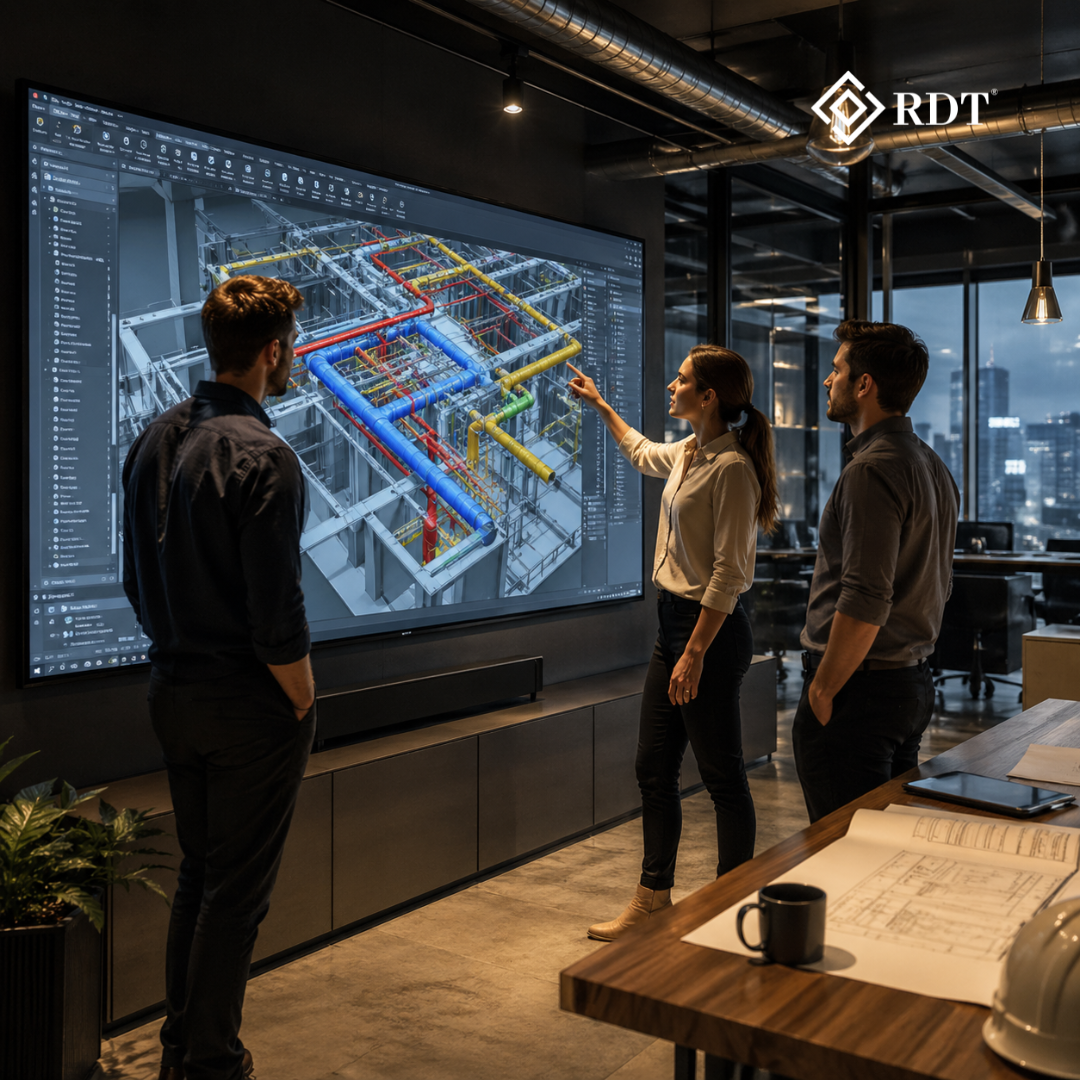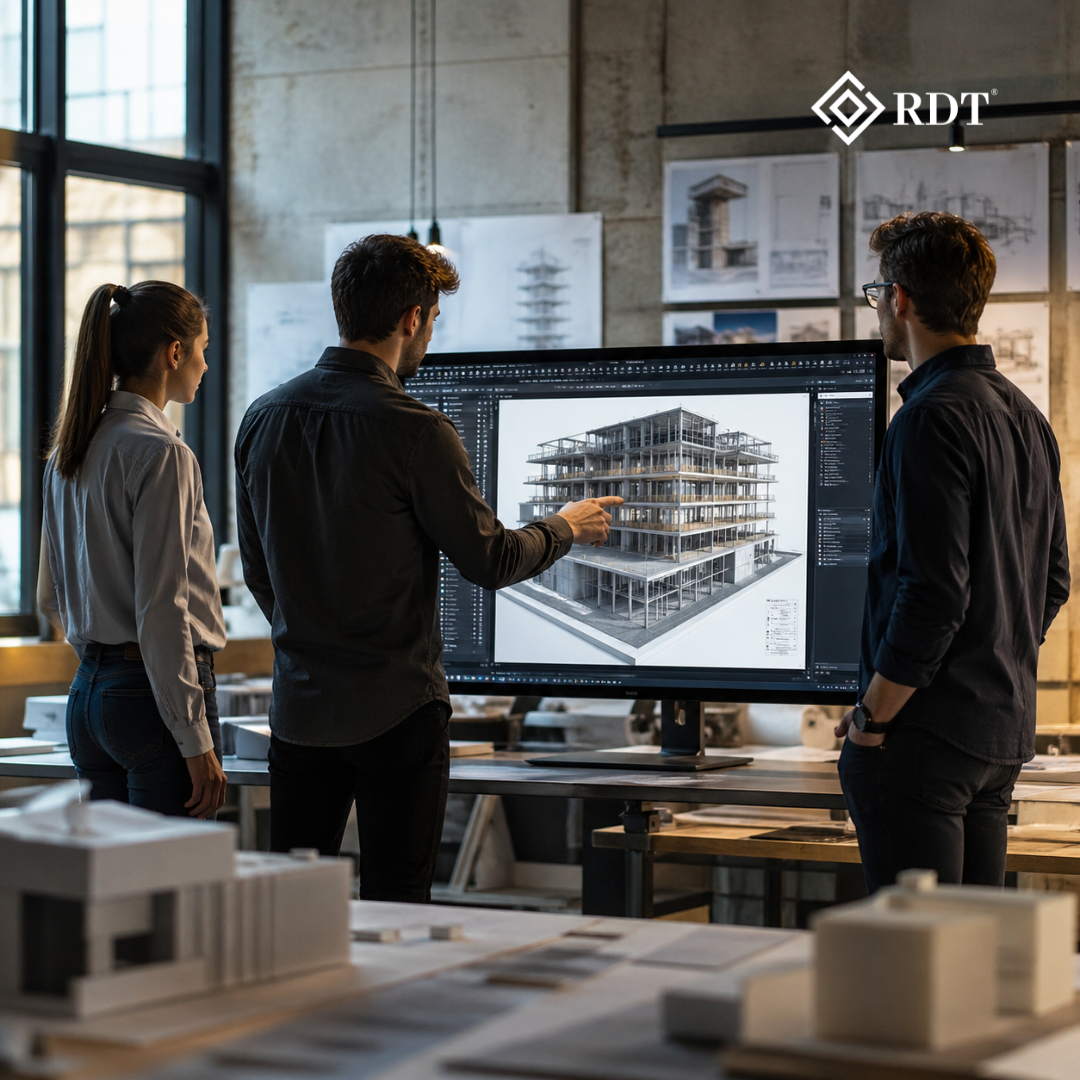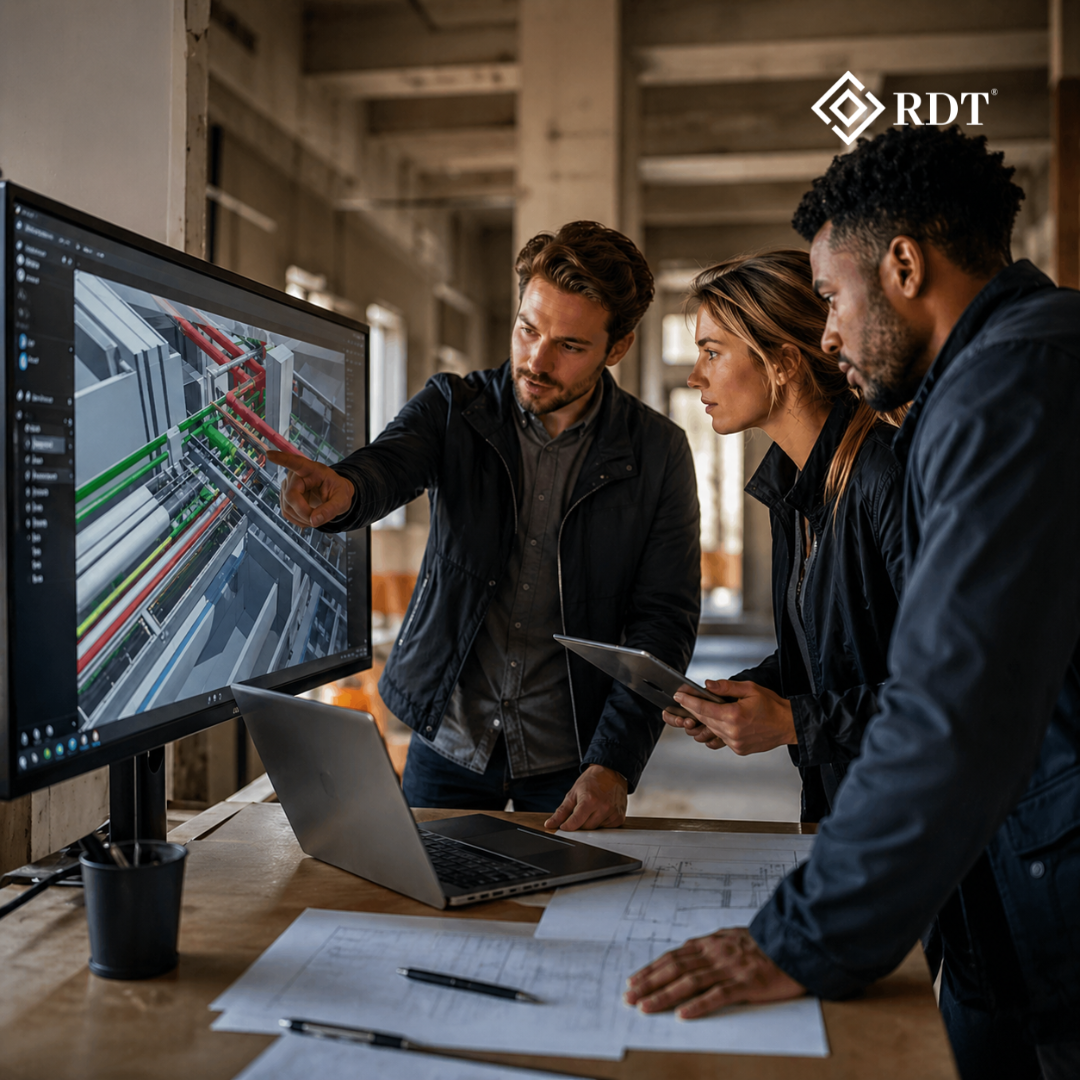

If you’re a general contractor navigating the fast-evolving world of construction, you’ve likely heard terms like BIM Modeling and explored countless BIM Modeling Examples in Construction Industry use cases. But beyond the jargon and digital excitement lies one core truth: project success today demands clarity, coordination, and certainty—three things that traditional 2D workflows simply can’t consistently deliver. And that’s exactly where the right experts—like RDT Technology: Your BIM Partner—step in to figure it out with you. But what absolutely is BIM for a general contractor, and is it something you are now required to follow?
Let’s clarify in a no-fluff, contractor-first way.
What Exactly Is BIM for a General Contractor?
BIM Is Not Just a Model—It’s a Construction Strategy
Most people mistake Building Information Modeling as just a detailed 3D model. But for general contractors, BIM is much more beneficial: it’s a harmonized, data-packed, step-by-step digital road map that displays how a building will be planned, constructed, and administered before physical work even starts.
If you peel back all the software layers, BIM for GCs really means:
- Understanding constructability early
- Predicting clashes before they become costly delays
- Seeing the exact sequence of work with 4D (time) simulation
- Knowing material quantities before a single order is placed
- Obtaining smoother approvals and cleaner submittals
- Handing over data that eliminates chaos during operation
Think of it as an on-demand “project foresight machine.”
Why GC’s Are Turning to BIM Quicker Than Ever
Construction has forever been about accuracy & preparation, yet job sites remain variable. BIM transforms that by placing all teams—architects, engineers, subs, owners—into an individual digital environment where decisions become clear, traceable, & provable.
Contractors who use BIM experience:
1. Fewer Surprises Onsite
With clash detection and coordinated drawings, BIM replaces “we’ll figure it out onsite” with “we solved it weeks ago.”
2. Predictable Scheduling
4D BIM simulations help you visualize:
- crane paths
- material staging
- subcontractor timelines
- potential bottlenecks
Construction stops being reactive and becomes fully choreographed.
3. Cost Control with Real-Time Quantities
BIM provides accurate BOQs, helping you protect margins and reduce excess ordering.
4. Stronger Bids
Contractors who use BIM often win more projects because owners trust clarity and risk-free planning.
5. Faster Approvals & Smoother Submittals
Engineers love BIM-based coordination because it removes ambiguity and improves documentation quality.
Is BIM Mandatory for General Contractors?
**Short Answer: Sometimes.
Long Answer: Soon, almost everywhere.**
Today, BIM mandates vary by region, project type, and authority. You’ll find:
- Government-funded projects in many countries now requiring BIM
- Infrastructure projects almost always demanding BIM deliverables
- Large private developers embracing BIM as a standard
- Global contractors making BIM compulsory across all new builds
Even when it isn’t mandatory on paper, it’s often mandatory in practice because:
- Consultants prefer BIM drawings
- Owners want digital handover
- Subcontractors rely on clash-free coordination
- Schedules demand digital planning
- Quality control needs visual verification
So while it may not yet be a universal legal requirement, BIM is rapidly becoming a competitive requirement.
Why BIM Matters Specifically for General Contractors (Not Just Designers)
Contractors don’t look at buildings the way designers do. Your world is site logistics, sequencing, labor efficiency, and safety—not just geometry.
BIM gives GCs visibility into:
1. Constructability
Can this be built this way?
Can equipment be installed in the sequence planned?
Will trades interfere with each other?
BIM answers in minutes what used to take weeks.
2. Coordination Across Trades
MEP-FP coordination alone saves thousands in rework.
With BIM, trades stop overlapping, conflicting, and guessing.
3. Site Management Using 4D Simulation
A simple schedule becomes a visual movie:
- who works where
- when materials arrive
- what areas are accessible
- how the site evolves week by week
GCs gain digital control over real-world complexity.
4. Risk Reduction
BIM drastically reduces:
- rework
- RFIs
- site conflicts
- change orders
Each avoided clash is real money saved.
BIM in Action — Real Use Cases for General Contractors
1. Structural vs MEP Clash Resolution
Rather than exploring a conduit where a beam should be, BIM identifies the clash before fabrication.
2. Prefabrication & Modular Coordination
BIM permits accuracy-based off-site fabrication—quicker, cleaner, & inexpensive.
3. Temporary Works Modeling
Scaffolding, shoring, and crane placements become predictable, safe, and optimized.
4. Material Planning & Logistics
Quantities update automatically, helping you manage procurement timelines and budgets.
5. Digital Handover for Facility Management
Everything installed onsite is tracked digitally:
- warranty details
- installation dates
- equipment specs
- maintenance logs
Facility teams love receiving this.
Are General Contractors Expected to Manage BIM Teams?
Not necessarily. Many GCs choose BIM partners—like RDT Technology—who:
- run clash coordination
- prepare shop drawings
- create 4D/5D BIM simulations
- manage model updates
- handle documentation
- run coordination meetings
So, no—GCs don’t need to manage BIM internally.
They just need someone reliable to stay and figure it out with them.
That’s exactly where your BIM partner steps in.
The Role of RDT Technology as “The Right Experts”
When we say “The Right Experts Will Stay to Figure It Out with You”, it means:
- we don’t walk away when things get complicated
- we reduce risks by turning uncertainty into clarity
- we simplify BIM adoption for GCs without adding burden
- we help you win bids with better visuals and stronger deliverables
- we handle technical BIM while you focus on construction
RDT Technology becomes an extension of your project team—your BIM department without overhead.
Final Thoughts — So, Is BIM Worth It for General Contractors?
Absolutely. BIM isn’t just a digital upgrade—it’s becoming the baseline for professional, competitive, and risk-free construction. Today’s construction atmosphere demands precision, coordination, and speed like never before. BIM provides gc’s that competitive benefit, assisting you deliver projects with transparency rather than chaos.
And as the industry moves toward digital-first construction, working with a trusted partner becomes essential. Whether you’re looking for BIM Modeling support or want to explore advanced BIM Modeling Examples in Construction Industry for your upcoming project, choosing the right experts makes all the difference.
Partner With RDT Technology for Your Next BIM Journey
If you’re ready to eliminate surprises, accelerate schedules, and win more confident clients, RDT Technology is here to build digital certainty into your next project.
Visit www.rdttech.co to book a consultation—your BIM transformation starts with the right experts who stay to figure it out with you.