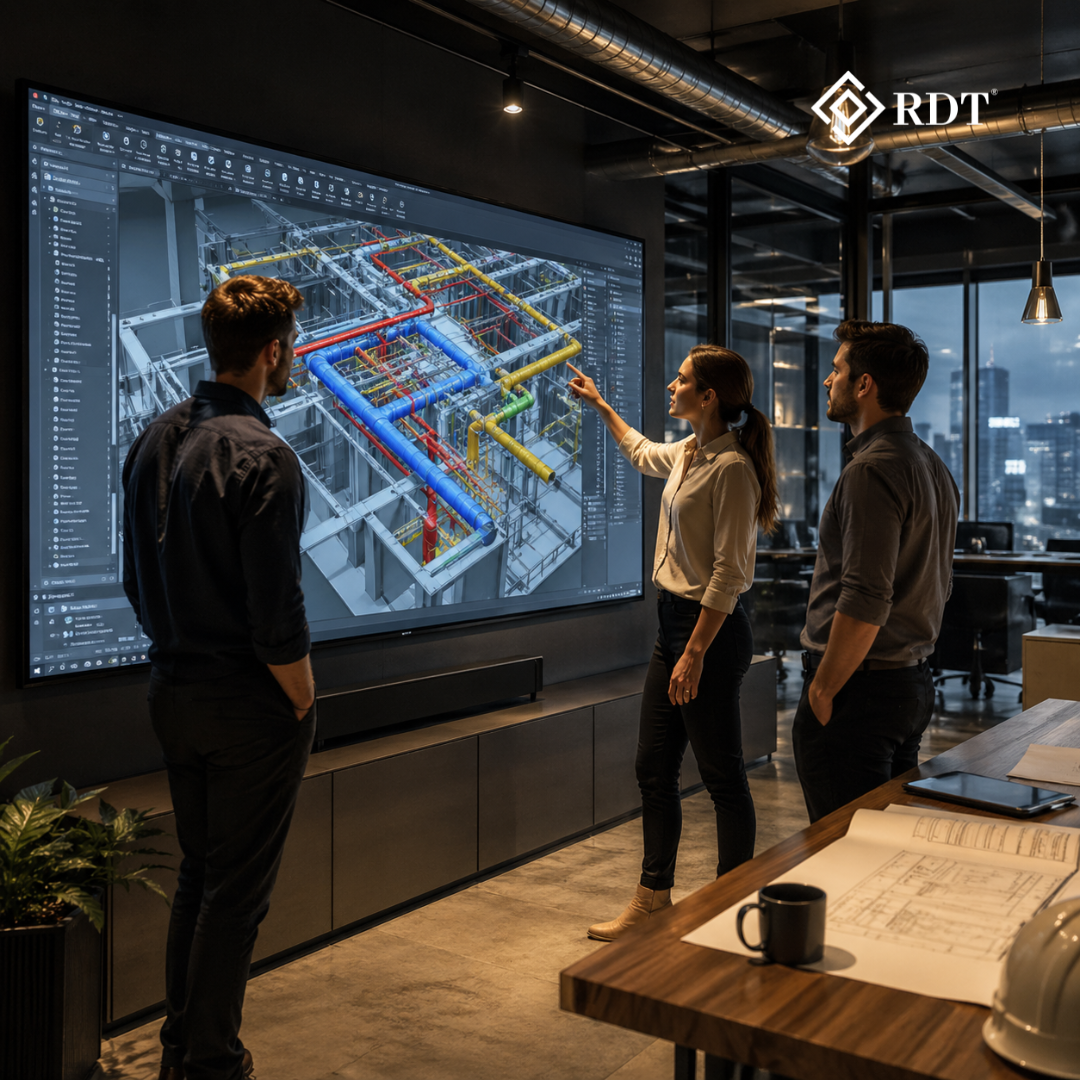

In today’s construction and design landscape, one truth is becoming impossible to ignore. Clients do not make decisions based on technical accuracy alone. They make decisions based on clarity, confidence, and emotional connection. This is where the visualization gap begins to reveal itself. It is the difference between what a project team understands and what a client is actually able to see and feel.
This gap is not always obvious. Many firms believe that detailed drawings, specifications, and presentations are enough to communicate their vision. They assume that clients will interpret plans the same way professionals do. In reality, most clients are not trained to read technical drawings. They struggle to translate lines and symbols into real world spaces. When that translation fails, hesitation begins.
And hesitation kills decisions.
Understanding the Visualization Gap
The visualization gap is the disconnect between imagination and perception. On one side, there is a fully developed idea inside the minds of architects, engineers, and designers. On the other side, there is a client trying to make sense of that idea with limited visual context.
This gap creates uncertainty.
When clients cannot clearly see the outcome, they begin to question everything. They question the design, the cost, the timeline, and even the team behind the project. Doubt replaces confidence, and decision making slows down.
In competitive environments, this delay often leads to lost opportunities. Clients move toward firms that provide clarity rather than complexity.
Why Seeing Drives Decision Making
Human beings are naturally visual thinkers. Long before written language, people relied on images to understand the world. Even today, the brain processes visuals far faster than text or numbers.
When a client sees a realistic representation of a project, something changes instantly. The design becomes tangible. The space feels real. The experience becomes personal.
This emotional connection is powerful.
It shifts the conversation from abstract concepts to concrete understanding. Instead of asking what the project might look like, clients begin to imagine themselves within it. That shift is often the turning point in decision making.
The Limits of Traditional Communication
For decades, the construction industry has relied on 2D drawings as the primary communication tool. While these drawings are essential for technical accuracy, they are not designed for client comprehension.
Floor plans, elevations, and sections require interpretation skills that most clients do not possess. Even with explanations, there is always a risk of misunderstanding.
Presentations and static images attempt to bridge this gap, but they often fall short. They provide a glimpse of the design but fail to deliver a complete experience.
As a result, clients are left with unanswered questions.
What will the space feel like
How will the lighting change throughout the day
Will the materials look the same in reality
How will different elements interact with each other
When these questions remain unresolved, confidence decreases.
The Cost of Uncertainty
Uncertainty has a direct impact on business outcomes. When clients are unsure, they delay decisions. When decisions are delayed, projects slow down. And when projects slow down, costs increase.
But the impact goes beyond time and money.
Uncertain clients are more likely to request changes. They seek reassurance by revisiting decisions repeatedly. This leads to revisions, rework, and additional effort from the project team.
In some cases, uncertainty causes clients to abandon projects altogether.
All of this stems from one core issue. They could not clearly see what they were committing to.
Visualization as a Decision Tool
Visualization changes the dynamic completely. It transforms communication from explanation to experience.
Instead of describing a space, teams can show it in detail. Clients can explore layouts, understand proportions, and evaluate design choices with confidence.
High quality visualization allows clients to see materials, textures, lighting, and spatial relationships before construction begins. It answers questions before they are even asked.
This clarity reduces uncertainty and accelerates decision making.
Building Trust Through Transparency
Trust plays a crucial role in any project. Clients need to feel confident that their investment is in safe hands.
Visualization builds this trust by providing transparency.
When clients can see exactly what they are getting, there is less room for doubt. They are not relying on assumptions or interpretations. They are making decisions based on clear and accurate representations.
This level of transparency strengthens relationships between clients and project teams. It creates a sense of partnership rather than transaction.
And strong relationships lead to repeat business.
Faster Approvals and Smoother Workflows
One of the most immediate benefits of visualization is faster approvals. When clients understand the design clearly, they are able to make decisions quickly.
This has a ripple effect across the entire project.
Approvals move faster
Design phases are completed more efficiently
Construction can begin without delays
The entire workflow becomes smoother.
This efficiency not only saves time but also reduces costs. Teams spend less time revising and more time executing.
Reducing Rework and Misalignment
Rework is one of the most common sources of inefficiency in construction. It often occurs when expectations do not match reality.
Visualization minimizes this risk.
By providing a realistic preview of the final outcome, it ensures that everyone involved has a shared understanding of the project. Misalignment is identified early and corrected before it becomes a problem.
This proactive approach saves resources and protects project timelines.
Standing Out in a Competitive Market
In a crowded market, differentiation is essential. Many firms offer similar services, similar pricing, and similar promises.
Visualization creates a clear point of difference.
Firms that invest in high quality visualization are able to present their ideas more effectively. They create a stronger impression and leave a lasting impact on clients.
While others are explaining their designs, these firms are showing them.
And showing always wins.
The Emotional Advantage
Beyond logic and efficiency, visualization taps into emotion.
When clients see a space that resonates with them, they feel a connection. They can imagine living, working, or operating within that environment.
This emotional response is often the deciding factor.
People do not just buy projects. They buy experiences, aspirations, and possibilities.
Visualization brings those elements to life.
Bridging the Gap Completely
The visualization gap does not have to exist. With the right tools and approach, it can be eliminated entirely.
Modern visualization techniques allow for immersive experiences that go beyond static images. Clients can explore spaces from different perspectives, understand details at every level, and gain complete confidence in their decisions.
This level of clarity changes expectations.
Clients begin to expect visualization as a standard part of the process. Firms that fail to provide it risk being perceived as outdated.
The Future of Client Communication
The role of visualization will only continue to grow. As technology advances, the ability to create realistic and interactive experiences will become even more accessible.
Clients will demand more clarity, more transparency, and more engagement.
Firms that adapt to this shift will thrive. They will build stronger relationships, close more deals, and deliver better outcomes.
Those that resist will struggle to keep up.
Final Thoughts
The visualization gap is not just a communication issue. It is a business challenge that affects decision making, efficiency, and profitability.
Clients say yes to what they can see because seeing removes uncertainty. It builds confidence, creates emotional connection, and accelerates action.
In a world where attention is limited and competition is intense, clarity is the ultimate advantage.
Visualization provides that clarity.
It turns ideas into experiences. It transforms hesitation into confidence. And it ensures that projects move forward with certainty.
Closing the visualization gap is no longer optional. It is essential for success.
Ready to Close the Visualization Gap and Win More Projects
If you want your clients to stop hesitating and start saying yes with confidence, it is time to upgrade how you present your projects.
RDT Technology specializes in high impact visualization and BIM solutions that help you communicate ideas with absolute clarity, reduce decision delays, and win more projects.
Take advantage of our world class BIM Modeling services engineered for seamless delivery of large, complex developments.
Connect with RDT Technology today and start turning your designs into decisions.