For a long time, experience was the backbone of the AEC industry. Decisions were trusted because they came from people who had spent years on construction sites, inside design offices, and across countless coordination meetings. If a senior engineer approved a detail, it moved forward. If a site manager said something would work, no one questioned it.
That approach shaped how buildings were designed and delivered for generations.
But the environment that supported that way of working no longer exists.
Projects today are not simply bigger versions of older ones. They are fundamentally different in scale, speed, and expectation. What worked reliably ten or fifteen years ago now carries risk. And relying on experience alone—without verification, data, or clarity—has become one of the industry’s quiet vulnerabilities.
When Experience Was Enough
There was a time when construction schedules had breathing room. If something did not line up perfectly, teams adjusted during execution. Minor clashes were handled on site. Coordination issues were solved through discussion, not dispute.
Most buildings followed familiar patterns. Systems were simpler. Stakeholders were fewer. Technology performed an encouraging role, not a defining one.
In that situation, experience performed as a secure net. People recognized problems early because they had seen similar situations before. Drawings did not need to anticipate every condition because skilled teams knew how to adapt.
That flexibility has disappeared.
Today’s Projects Don’t Forgive Oversight
Modern AEC projects operate under constant pressure. Delivery timelines are compressed. Budgets are tightly controlled. Margins leave little room for error. Clientele expects results, not justifications.
Buildings now integrate complicated structural systems, dense service networks, sustainability needs, digital infra, & administrative compliance—all within confined space & aggressive schedules.
An individual unresolved coordination problem can impact various trades. One overlooked clearance can disrupt installation sequences. One assumption can trigger weeks of rework.
No matter how experienced someone is, no one can hold all of this in their head anymore.
Experience Has Limits—Even Good Experience
This is not a critique of enterprise vets. Indeed, the opposite is true. Skilled professionals understand the threat more than anyone. They know where projects typically fail.
But experience is shaped by the past. And many of today’s challenges simply did not exist when that experience was formed.
Building systems are more integrated. Design and construction phases overlap. Decisions are made earlier, with less time to adjust later. The margin for correction has shifted upstream.
What once could be solved through on-site judgment now needs to be identified long before construction begins.
The Danger of Familiarity
One of the biggest risks of relying on experience alone is familiarity. When details look familiar, teams are less likely to question them. When layouts resemble previous projects, verification is often reduced.
Nothing appears wrong—until work reaches the site.
That is when conflicts reveal themselves. Services intersect where they shouldn’t. Access zones disappear. Installation tolerances are exceeded. Maintenance paths are blocked.
These are not failures of competence. They are failures of visibility.
Experience tells you what usually works. It does not guarantee that everything works together in a specific project.
Construction Is No Longer a Place for Discovery
In the past, construction sites absorbed uncertainty. Today, they amplify it.
Any issue discovered during execution carries financial, contractual, and reputational consequences. Changes ripple through schedules, procurement, and sequencing. Conversations turn into claims faster than many teams expect.
Clients increasingly ask one question when problems arise: Why wasn’t this identified earlier?
Experience without evidence does not answer that question.
Data Has Become the New Baseline
The industry is shifting—whether it admits it or not—from intuition-based decisions to data-supported ones.
This does not mean removing human judgment. It means strengthening it.
Accurate models, coordinated documentation, and clear visualization now form the baseline for responsible decision-making. Assumptions must be tested. Conflicts must be resolved digitally before they appear physically.
Judgment still guides priorities. But data confirms accuracy.
Without that balance, even the most confident decisions carry unnecessary risk.
Drawings Alone Are No Longer Enough
Traditional drawings were never meant to carry the full weight of modern construction complexity. They communicate intent, but not always reality.
Various investors interpret them variously. A plan might emerge obvious to a designer but vague to a contractor. A section might meet standards but fail in installation.
This gap between design and execution is where many projects struggle.
Experienced professionals know this gap exists. But knowing does not eliminate it. Only clarity does.
Accountability Has Shifted Upstream
Responsibility in today’s projects is more clearly defined than ever before. Approvals are tracked. Decisions are documented. Coordination is audited.
When something goes wrong, the focus is not on fixing the issue alone, but on understanding why it passed through earlier stages unchecked.
Experience without traceability offers little protection in this environment.
Modern practice requires decisions that can be explained, supported, and justified—not just remembered.
Knowledge Must Live Beyond Individuals
Another challenge of experience-driven workflows is dependency. When knowledge lives only in people, consistency becomes fragile.
Projects succeed when the right individuals are present and struggle when they are not. Teams change. Companies grow. Senior professionals move on.
Without systems that captivate & shift knowledge, the industry replays mistakes it already knows how to bypass.
Experience should inform procedures, not replace them.
Time Is the Tightest Constraint
Perhaps the most significant change in the AEC industry is the loss of time as a buffer.
Fast-track delivery, phased construction, and overlapping scopes leave no room for late discovery. Problems identified during construction are no longer inconveniences; they are threats to delivery.
Relying on experience assumes time will be available to adjust. In reality, time is often the first thing that runs out.
Prevention has become more valuable than problem-solving.
Seeing Before Building Changes Everything
One of the most meaningful shifts in how projects succeed today is visibility.
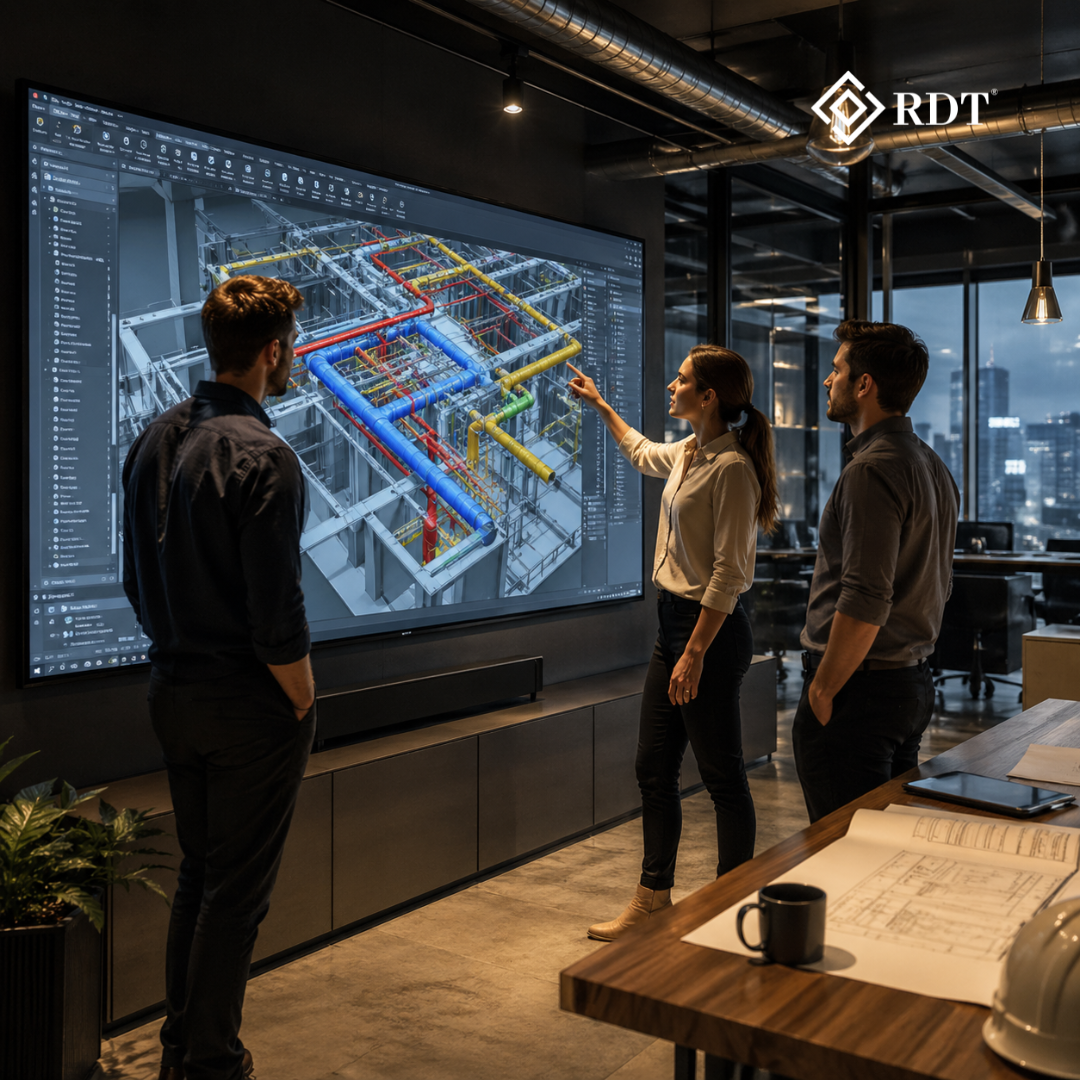
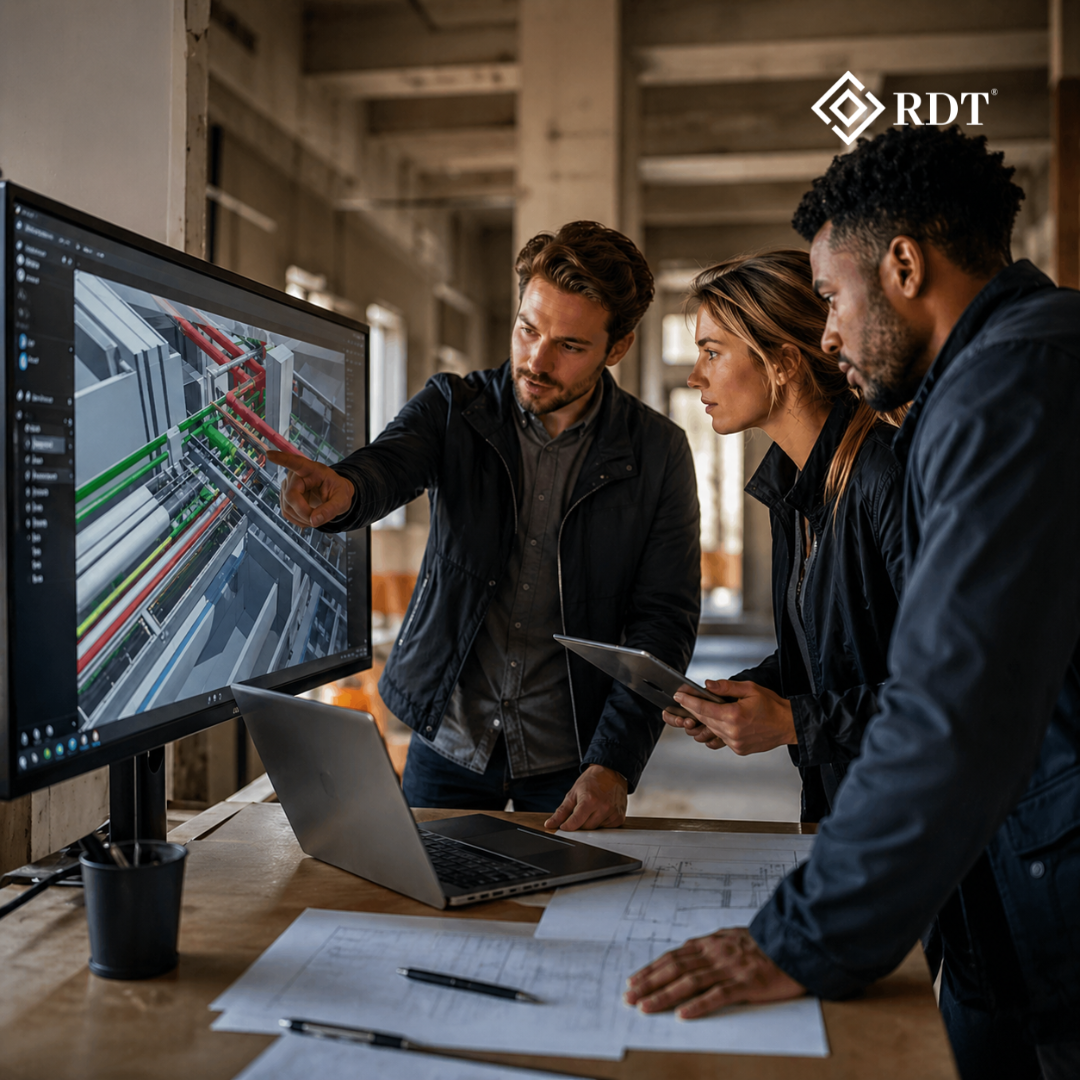
When teams can clearly see what is being built—how systems interact, how spaces function, how installation will occur—decisions improve. Questions surface earlier. Misunderstandings are resolved before they become expensive.
This benefits everyone, including the most experienced professionals. Clear visualization strengthens judgment instead of challenging it.
Experience Is Still Essential—Just Not Alone
None of this suggests that experience has lost its value. It remains critical. It provides context, foresight, and understanding that tools alone cannot offer.
But experience must evolve.
It must work alongside structured workflows, coordinated information, and reliable validation. It must be supported by systems that reduce dependency on memory and minimize risk created by assumption.
The strongest teams today are not those with the longest resumes, but those who combine insight with clarity and judgment with proof.
The Industry’s New Reality — Insights from RDT Technology
The AEC industry has reached a point where relying on experience alone is no longer a sign of strength. It is a liability.
Projects are too complex. Expectations are too high. Consequences are too severe.
Experience remains the foundation—but it can no longer be the entire strategy.
The future belongs to teams that respect experience while recognizing its limits. Teams that invest in understanding before execution. Teams that replace assumptions with certainty.
Because in today’s construction environment, the most expensive problems are not the ones that happen on site—but the ones that could have been avoided long before work began.
Strengthen collaboration, eliminate assumptions, and bring certainty to every project with RDT Technology—discover how at www.rdttech.co.